Q. why is fossil record important to know about evolution over times?
The fossil record is life’s evolutionary epic that unfolded over four billion years as environmental conditions and genetic potential interacted in accordance with natural selection.
Q.what are two major hypotheses on how evolution takes place?
gradualism and punctuated equlibrium
Q. what is Divergent speciation?
Divergent speciation suggest that a gradual accumulation of small genetic changes results in subpopulation of a species, that eventually accumulate so many changes that the subpopulations become different species.
facts
1.The age and morphologies (appearances) of fossils can be used to place fossils in sequences that often show patterns of changes that have occurred over time.
2.Fossils are traces of organisms that lived in the past.
3.Gradualism suggest that organisms evolve through a process of slow and constant change.
4.Punctuated equilibrium suggests that species evolve very rapidly and then stay the same for a large period of time.
5.Phyletic speciation suggests that abrupt mutations in a few regulatory genes occur after a species has existed for a long period of time.
diagram

fossils illustrate representative organisms from different points in time. the fossil record shows that there have been great changes in the kindso forganisms that dominated life on earth at different points in time. Many past organisms were unlike today;s organisms, and many organisms that oncewere common are now extinct.
video
http://www.youtube.com/watch?v=JiTMJFdMlcQ
summary
A subterranean evolution of life has also been suggested. Rock layers deep below the continents and ocean floors, that were previously thought to be too poor in nutrients to sustain life, have now been found to support thousands of strains of microorganisms. Types of bacteria have been collected from rock samples almost 2 miles below the surface, at temperatures up to 75 degrees Celsius. These chemo-autotrophic microorganisms derive their nutrients from chemicals such as carbon, hydrogen, iron and sulphur. Deep subterranean communities could have evolved underground or originated on the surface and become buried or otherwise transported down into subsurface rock strata, where they have subsequently evolved in isolation. Either way, these appear to be very old communities, and it is possible that these subterranean bacteria may have been responsible for shaping many geological processes during the history of the Earth


 this small widlflower population has a stable size of ten plants. suppose that by chance only five plants of generation 1 produce ferile offspring. this could occur, for example, if only those plants happend to grow in a location that provided enough nutrients to support the production of offspring. again by chance, only two plants of generation 2 leave ferile offspring. as a result, by chance alone, the frequency of the a allel first increases in generation 2, then falls to zero in generation 3.
 gene cloning is useful for two basic purposes: to make many copies of a particular gene and to produce a protein product. In this simplified diagram of gene cloning, people start with a plasmid isloated from a bacterial cell and a gene of interest from another organism. only one copy of the plasmid and one copy of the gene of interest are shown at the top of the figure, but the starting materials would include many copies of each.
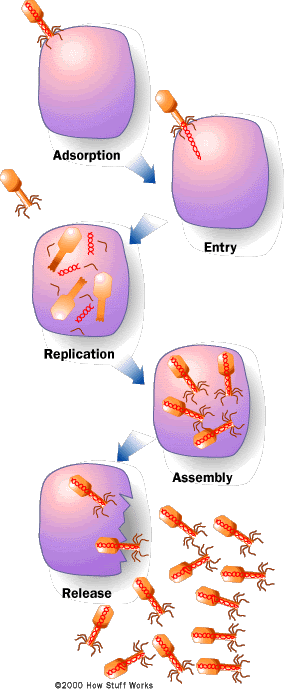 fist, the T4 phage uses its tail fibers to bind to specific receptor sites on the outer surface of cell, and the sheath of the tail contracts, ingecting the phage DNA into the cell and leaving an empty capsid ouside. the cell's DNA is hydolyzed. The phage DNA directs production of phage proteins and copies of the phage genome by host enzymes, using cimponents withing the cell. three separates sets of proteins self-assemble to form phage heads, tails, and til fivers. the phage genome is pakcaged inside the capsid as the head forms, it released with a lot of damages on the cell.